PayPal Inc. (PYPL US) the fintech or digital payments company is currently “in play” following news that Stripe, and Advent International are looking to buy the company at $60.50 per share. Fundamental analysis reveals that the stock is heavily mispriced and undervalued. The question remains whether the board will be able to squeeze out what they deem is value for the company and its shareholders. We analyze if it is possible to take advantage of the current trade setup.
Trade Summary
PayPal Inc., a fintech company, which serves the global digital payments ecosystem has recently received an
unsolicited bid from a consortium including Stripe and Advent International – a PE company which specializes in certain niches, one of them being business services and finance. Receiving an initial offer of $60.50 per share, which the board has rebuked, the company remains extremely undervalued fundamentally. Furthermore, given its long-term turnaround to focus on TPV margins and reducing overhead costs, an offer from a PE firm, which recently bought Nuvei, and a fintech player such as Stripe could allow the buyers to unlock long term value and synergies.
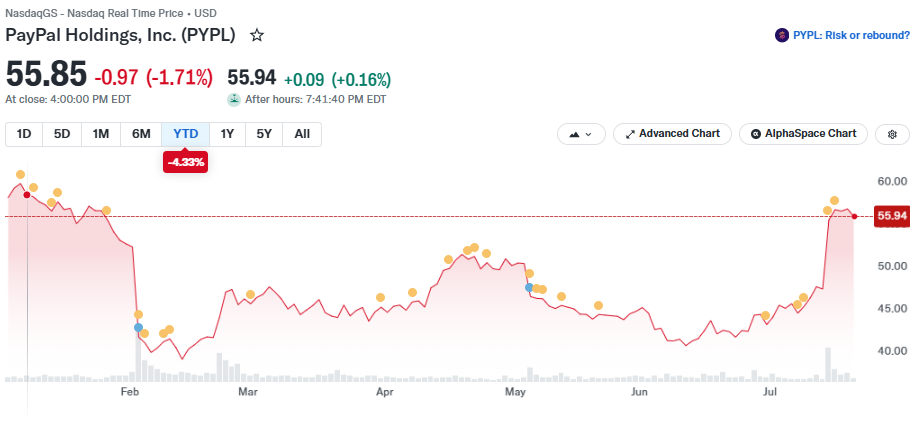
The company recently trading at $56.56, is valued intrinsically anywhere from $66 to $90 based off of SOTP and DCF valuations. As the discussions are still on-going and there remains chatter of a topping bid or a repriced offer, a call spread might be utilized in order to lock-in a trade which has a defined downside, and sizeable upside with the potential for the position to become asymmetric in nature.
Fundamental Valuation
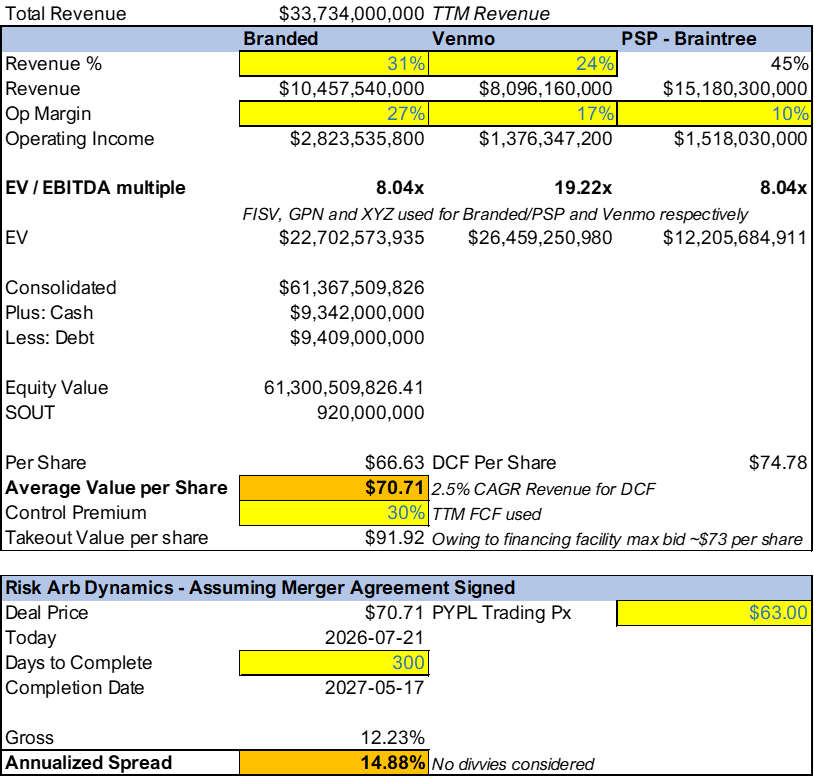
SOTP analysis indicates a total share valuation of $66.63. This figure was arrived at backing out the respective
operating incomes from the Branded Payments, PSP/Braintree and Venmo services offered by PayPal. Comparables were applied using XYZ US, FISV US, GPN US and ADYEY US for the EV/EBITDA multiple. Simultaneously, a DCF valuation with a 2.5% revenue CAGR provides us with a per share valuation of $74.78.
Assuming the turnaround to be possible and successful, increasing the CAGR to 4% provides us values around $95 per share thereby bringing the valuation range of the company from anywhere between $66 to $95 on a fundamental basis. However, using conservative estimates and the average gives us an intrinsic value of $70.71.
Trading the Setup
Given that a higher bid in the range of $70 per share is highly possible owing to the many factors, we can back out the potential price at which PayPal might trade post signing of the merger agreement. Given that this will be a large deal and will face regulatory scrutiny globally, I have estimated that the stock could trade at an annualized spread of close to 15%. It must be noted that assuming 300 days to close, the initial price action of the stock around $53.95 post news of the unsolicited bid, also indicated an approximately 15% annualized spread to the deal. However, the stock has priced in potentially higher offers as per my analysis owing to which it has traded a touch higher to where it is right now.
My estimate of the 15% annualized spread has been derived from other mergers, the UNF/CTAS merger which has faced H2R (HSR 2nd request), and the fact that post signing the DMA, it will likely take close to a year to close. We can use a call spread employing the calls with 60/65 strike price and expiring Jan 15, 2027 to try and take advantage of the current setup. Employing the call spread allows us to put up minimal capital, whilst also having a defined loss which can be managed within the portfolio limits.
With a maximum net return of 222.58% on the capital at stake, I expect that if the deal is signed for a takeout at
$70.78, the stock would trade up to $63 or so and net a profit of 93.55% on the capital put at stake through the
options (the debit spread total). The return values have been computed assuming that the options are held to expiry.
An increase in the volatility of the options before expiry and deal announcement could also present an opportunity to close the trade earlier. The payoff profile mirrors that of a call spread and breakeven price would be $61.55 assuming a net debit of $1.55 on the spread.
The spread can be set using capital which the portfolio can withstanding losing. For the sake of assumptions, I have assumed a portfolio of $1milliion and a maximum downside of 50bps for the trade, which gives us a position involving 32 contracts. The options expiring in Dec or Jan 27 OpEx are relatively liquid around the strike prices mentioned (i.e.60/65).
It is to be noted that we have selected a spread involving the aforementioned strikes as it offers us the highest percent return on capital employed compared to the other strikes at the current option premia. Additionally, given the limitations of financing and the fact that the offer is likely to be rangebound from $60 to potentially nearabout $70 per share, I believe this spread also provides us the optionality of capturing the full $5 spread net of the debit in the eventuality that the stock trades above $65 post announcement of a deal or before any deal signed as we see a bidding war take shape.
Risks and Conclusion
The primary risk facing the trade is that the deal will either not be announced or if a deal is announced, we do not see incrementally higher offers as discussed in the range of north of $70 per share. There also exists a risk that on receipt of and signing the merger agreement, the stock trades below or at breakeven point of the call spread in spite of a considerably higher takeout offer received by the company. Lastly, expiry of the options before deal announcement would also result in a complete loss of capital.
It remains to be seen, what outcomes await the company and the stock of PayPal, however, utilizing the call option spread could allow one to minimize risk and capture the upside in a capital efficient manner. Additionally, purchasing the stock outright would make for a logical undertaking only if the Portfolio Manager would not mind a fundamental exposure to the underlying which would come into play in case a deal does not materialize for the company.