A QSR and Casual Dining Franchisor, MTY Group also operates Food Processing and Distribution segments. Currently listed on the TSX and trading Pink Slip in the US, this company is grossly undervalued and is a typical Ben Graham stock on sale. A PE firm and Fairfax Financial are said to be interested in acquiring this company, which lends an event-driven setup. However, the company’s position and recent history suggest that this stock still has legs to run and be a multi-bagger should the sale not materialize (All figures mentioned are in Canadian dollars unless stated otherwise)
Summary & Thesis
Accrue shares of this company below or at $35 per share so as to minimize downside risks ($14 during COVID-19 but adjusted to $22 for closing price) and participate in an event-driven trade. Given the strong fundamentals of this company, in the event that a sale does not materialize, this could turn out to be a potential multi-bagger with a 10 year price target of $120 per share for a 13% CAGR investment ex-dividends.
(This post is not to be treated as investment advise and should only be used for research purposes)
Background of MTY Food Group
Founded by Stanley Ma, a Hong Kong immigrant based out of Quebec a few decades ago in 1979, MTY Group (TSX: MTY CN Equity, OTC: MTYFF US Equity), is a fast-food, casual dining and QSR restaurant franchisor. The company doesn’t run a pure play franchise model and also runs corporate owned stores.
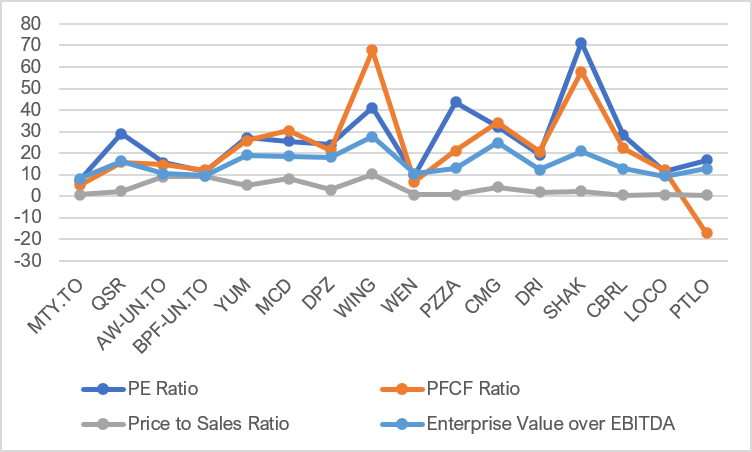
Currently trading at cheap valuations of 6.90x PE, a 15% earnings yield and a 20% FCF Yield, the company’s stock is attractively priced. It also trades at a EV/EBITDA multiple of 6.65x (TTM). Whilst some may attribute this to negative recent sentiment given the decline in revenue, especially of the corporate owned stores as well as consumer weakness, astute operation and execution have seen this business generate revenue growth CAGRs north of 20% over the last 10Y and 15Y period.
It primarily operates out of Canada and the USA, with a sprinkling of the topline coming from International markets (3%). Canada accounts for 31% of sales with USA coming in at 66%. The company operates a total of 7080 stores with 75 of those being company owned.
It launched a strategic review process last year around November 2025, and recently announced closure of 68 of its stores – all of which are corporate owned. Whilst this resulted in one-time charges flowing to Net Income, this is net-net a positive for the long run as management seeks to execute and focus on profit generating operators. It is to be noted that the store closures have mainly been based in Canada, given that the Canada based owned locations have generated losses as compared to the profitable USA based locations.
In a similar vein given we are on the topic of strategic reviews, Serruya Partners and Recipe Unlimited – a Fairfax company, which was taken private by Fairfax circa 2022, have been said to place bids for the company, which started at $52-53 range and thereafter bumped up to $60. Given the iffy and unconfirmed nature of the above report, the stock has not responded as one would have expected it to, on receipt of the news by the markets. But more on this later.
It is also to be noted that the founder, Stanley Ma, controls 13.90% of the company through share ownership. There is no dual class structure for this business. It is also widely reported, that Claude St-Pierre, who is said to be married to Stanley and one of his daughters Katherine are involved in the business either through board seats or as employees in the marketing and ESG department of the company. Whilst I could not confirm, it does appear that there is also another family member who is operating in Procurement – another important operating line for the business. Recent sales of the shares of the company by Stanley in the $63 range were said to be for tax and estate planning purposes. These took place in 2023.
Fundamentals & Share Pricing Dynamics
The business has grown well fundamentally and is continuing its topline and bottomline growth at a clip. Whilst recent sell-side research notes and X discourse are focusing on the negative topline growth in recent quarters leading to negative sentiment, it is important to remind oneself that under the Ma family, the company has grown its topline at a CAGR north of 20%, as noted above.
Revenue growth has been noticeably tepid over the last five years at a 50bps annualized rate, although I put that largely down to the softness in consumer sentiment, lower growth as well as tougher consumer conditions over the last so many years since COVID-19, especially commencing 2022 onwards, wherein we entered recession for a short period, and once again in Canada this year. However, the management is taking action in re-sizing its portfolio and focusing on brands and locations which can turn a profit. At a fundamental level, the company is also overhauling its IT infrastructure so as to focus on data localization and centralization – something which will surely benefit management from a decision making perspective given that the analytics can be built out around the above.
Additionally, the company has also been buying back shares until November 2025 which was when it announced its strategic review to create shareholder and business value for shareholders and owners respectively. The stock is currently down -10.89% on a YTD basis, -49.41% on 3Y and -49.38% on a 5Y basis. Given that operating cash flows have grown at 15% annualized over the last 10 years, and revenue close to 20%, we can see why the markets are currently mispricing (read as sentiment and recent quarters) the company leading to a detachment of fundamentals from its stock price.
Moderately leveraged and capitalized at a debt / equity ratio of 124%, the company if it relies only on its Unlevered Free Cash Flow, can repay the debt in close to 9 years, given it generates $7.40 free cash flow per share. The debt matures 2028, and I foresee the company either paying off a large chunk of debt, which will reduce interest expense and push up earnings, and thereafter refinance to push out the runway as well as use leverage for growth and grow its ROE which is also a generally attractive 13.89%.
Dividends are well covered over four times by Levered Free Cash Flow (or Free Cash flow to Equityholders, i.e. after accounting for debt expense and dividend payouts), and I can see the company continuing to prudently hike its dividends over the long term. With $2.26 cash per share and a book value of $37.28 this is an extremely Ben Graham’esque company. True to its nature, valuing the company using the Graham formula, gives us a figure of $65.87 per share. It presently trades at $33.97 or 45-50c on the dollar if using the Graham formula to value the company.
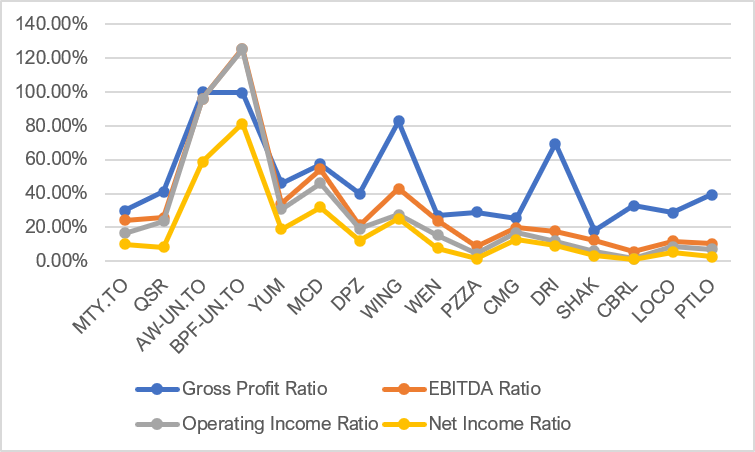
It is to be noted that compared to its peers in the USA and Canada, the company is priced at a relatively cheap valuation. Other than Wendy’s (WEN US), which also has a low PE of 9.7x and a 15% FCF yield, almost all of the incumbents are trading north of 12x EV/EBITDA and 16x PE ratio. However, it needs to be mentioned that unlike MTY Group, Wendy’s business performance has been nothing to write home about and in fact has lagging revenue and operating cash flow growth compared to peers (about 7-8% CAGR over a 10Y period).
It should also be mentioned that unlike its peer group, MTY Groups CapEx nets out at close to 15% of its Depreciation and Amortization expenses, showing that the Net Income reported is usually depressed given that it covers more than 9 times is CapEx spend. Other peers regularly under-report their DA when compared with CapEx.
Backing out its numbers from its system sales and revenues, we can see that the company roughly charges a 7.4% topline royalty and a 2.1% royalty fee for its Advertisement fund, which brings the blended rate to 9.5% or thereabouts. ($421.9m franchise revenue, $121.7m advertising, and $5698.4m in system sales)
Furthermore, a good 62% of its revenues accrue from Streetfront stores, 16% from office complexes & malls and the remainder from non-traditional stores such as airports, or convenience centres. One should note that the information presented to investors in the filings is fairly adequate and does a good job of breaking out numbers unlike many businesses.
This brings us to the valuation of the company as well as tying in the numbers with the rumored bids from Serruya and Fairfax Financial (Recipe Unlimited).
Valuation & Merger Math
For the purpose of this exercise, I will try to be roughly correct on the valuation and thereby keep my assumptions simple. Given that I can foresee the company re-rating its multiples in the distant future during a better climate or when better sentiment prevails, we will use both DCF and SOTP valuation. Another reason to use the SOTP valuation in tandem with the DCF is the limitation of the DCF to model out valuation where the terminal growth rate is higher than the discount rate or the WACC used for calculation purposes. It is also to be noted that the limitations of SOTP dictate that this valuation will be driven by how the markets are pricing its peers as well as the peer selection group thereby adding the vagaries of pricing to this valuation exercise.
To start with I backed out the revenue by segment and calculated the segment EBITDA using the operating expenses disclosed in the Annual report of FY25.
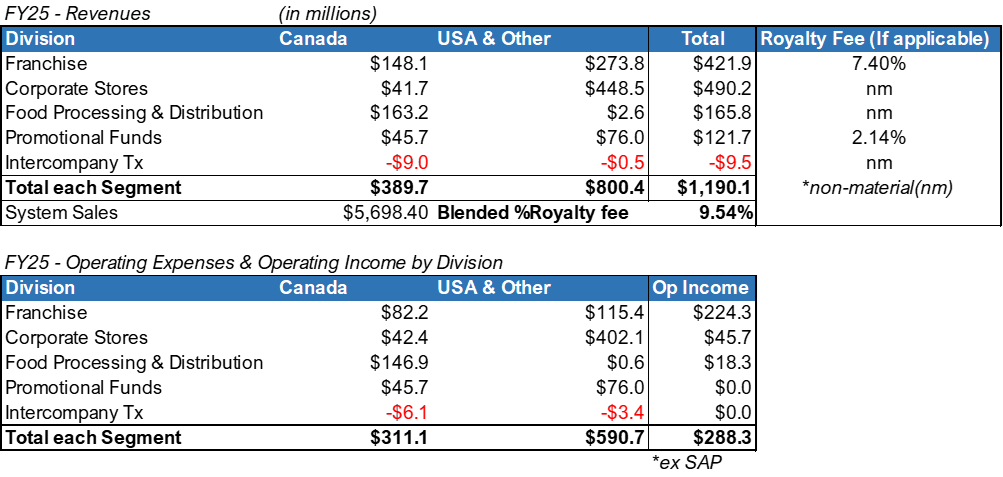
A one time charge of SAP system restructuring was excluded from the calculations. As we can see above, the company is generating a total of $288.3 million in EBITDA combined from all of its segments. Promotional Funds accounts to zero given that centralized marketing and branding campaigns are being run using the monies raised from the franchisees. Using a peer set which includes Franchisors (QSR US, AW/UN CN, BPF/UN CN, YUM US, MCD US, DPZ US, WING US, WEN US, PZZA US), Owner Operators (CMG US, DRI US, CBRL US) and Food Processor and Distributors (SYY US, USFD US) we achieve an Enterprise value of $4B and a per share value of $137.45.
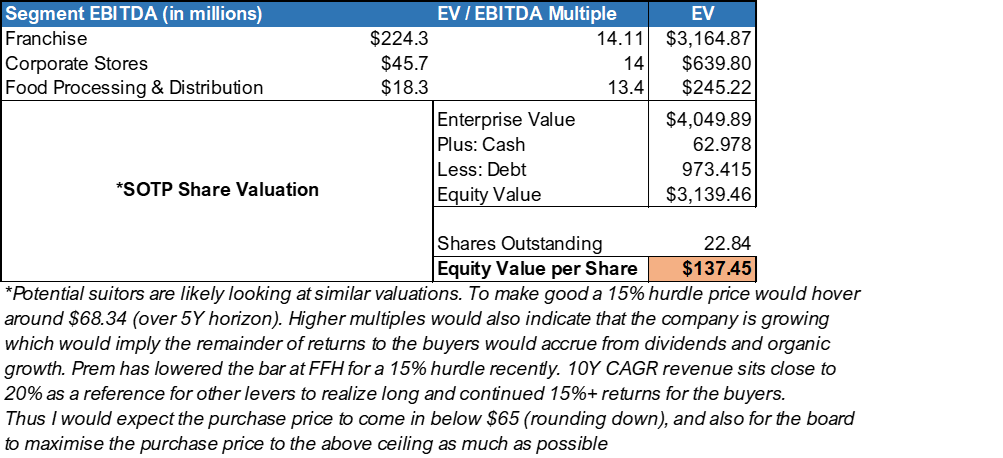
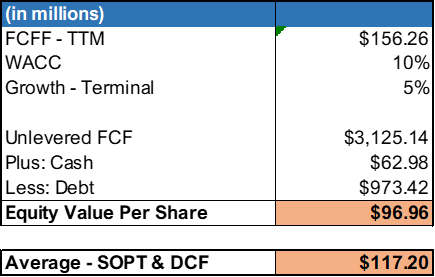
And as can be seen, using a 10% WACC and a 5% growth rate provides us with a DCF & SOTP average valuation of $117.20 per share. One can argue that the WACC rate used here is higher than actuals for the company which should be close to 8% or so and as well that for a company which has netted a run-rate of 21% topline growth CAGR over the last 15Y, using a 5% might be out of touch. However, a 5% growth sits nicely adjusted on top of a 2.5% inflation and another 2.5% growth. Also consider, that as the company grows the annualized growth numbers are likely to normalize to the industry averages and down to the single-digits.
In addition to the valuation excerpts, also have a look at the footnote to the SOTP valuation, which is what is going to kick off our “merger math”. To start with, I have once again used the reasonable assumption that the financial or strategic buyers (read as the PE firm or Fairfax) would likely want to clear a 15% hurdle rate on their initial investment in the company. As the footnote says, for that to happen they will need to purchase the business at or below $68 per share. Looking at a runway more than 5 years however, the business will have to continue to execute flawlessly as well as continue to grow organically and by acquisitions. Slotting into the Fairfax group of companies, one can also expect Prem and Fairfax to use the dividend lever to generate the returns as well as continue to grow its float.
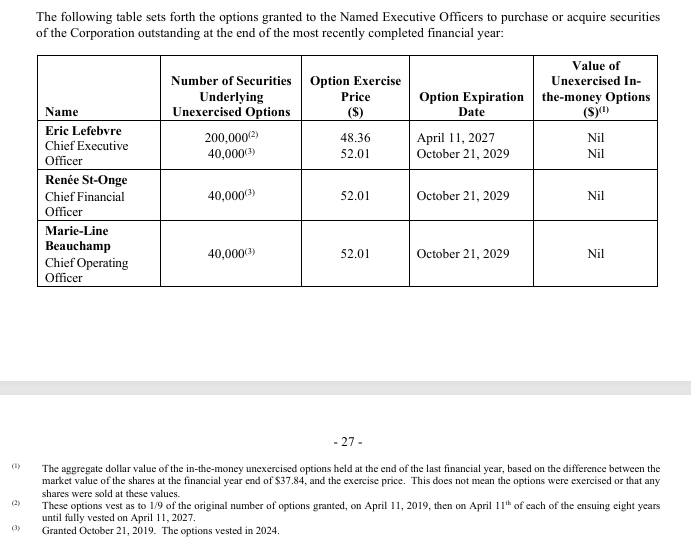
Furthermore, what was interesting to note was that the board lacks any LTIP which will bode well for the new home that they are about to potentially occupy, given that this gives leverage to the new owners to engage with Stanley and the Ma family along-with the executives to set renumeration, likely cash based instead of giving out stock of the company. Additionally, as mentioned above, the opening bids of $52-53 has as per me, the signature of Fairfax written all over it. Consider that three of its executives have vested options with a strike price of $48.36 and $52.01 with 200,000 (not fully vested) and 120,000 total shares, all-in a $53 bid would keep the top team happy as they realize a gain on their options, and as well would show prudence in the markets by squeezing out the price beneficial for the new owners. This would not add materially to the purchase price of the company.
However, keeping in mind this interesting development it should be no surprise to us given the above discussion as to why rival bids or competing offers have ratcheted up the bids close to $60 per share. Either ways, If I were to take a guess as a betting man, I would say that the company would feel right at home under the Fairfax umbrella. This would also potentially allow the Ma family to continue to be involved, by rolling over their shares and participate in the continued growth of the company.
It is also clear as to why such an undervalued business makes for a compelling takeover opportunity for both – financial and strategic buyers. Either ways, I do hope that the board does its best to realize maximum value for its shareholders, given that they are free to roll-over their shares as compared to the average investor.
Risks to Thesis & Conclusion
The risk to this thesis is simple, in that the sale falls through or doesn’t materialize and the company continues to operate in the public markets. However, sentiment is short-lived and humans have short memories – I expect this stock to potentially be a multi-bagger investment as a fundamental long assuming the sale process comes to a nought. Arguably, it could also be said that Stanley, and his entrenched family, would be offered a cozier home as a subsidiary of a large financial powerhouse or a PE shop.
Although no one knows what the outcome of the sale process is going to be like, I am inclined to pony up the monies and hold this name as a long term compounder. If the sale does come to pass, it would be essentially a capped call option on this name. It was the best of times, It was the worst of times…